Legacy Documentation
Desktop And Mini DBA Server
Legacy Documentation Home
alerts
analysisservicesalerts
analysisservicescpu
analysisservicesdashboard
analysisservicesdatabases
analysisservicesio
analysisservicessessions
azurealerts
azuredatabase
azuredatabasehealthcheck
azureindexes
azurelocks
azure security
azuresessions
azuresql
azuresqldatabase
azuresqldatabasedashboard
azuresqldatabases
azure sql server dashboard
azuretables
azurewaits
compare performance baseline
connections
cpu
custom sql server alerts
database
database query performance
databases
defaulttrace
dm exec query statistics xml
documentation
errorlog
files
gettingstarted
healthcheck database
healthcheck sql server
history active
history blocking
history data storage
history deadlocks
history files
history memory
history viewer
history waits
howtoperformancetuneazuresqldatabase
how to performance tune sql server
how to sql server performance tuning
how to sql server query tuning
indexes
Installation
io
License Support
locks
maintenance windows
options
performance history
security
server
servergettingstarted
Server Installation
server memory
serveroptions
serversecurity
servertroubleshooting
sql database memory
sql execution plan
sql extended event sessions
sql server activity
sql server alert configuration
sql server alerts
sql server database
sql server execution plan view
sql server index defrag jobs
sqlserverindexfragmentation
sql server index fragmentation
sql server index maintenance
sql server live query statistics
sqlserverqueryperformance
sql server query performance
sql server send slack alerts
sql server send teams alerts
sql server transaction log
sql server wait statistics
tables
tranlog
waits
webmonitorconfigure
webmonitorconnections
webmonitorcurrent
webmonitorcustom
webmonitorenterprise
webmonitorgettingstarted
webmonitorhistoric
webmonitorinstallation
webmonitorio
webmonitormemory
webmonitoroptions
webmonitoroverview
webmonitorsecurity
webmonitorwaits
wmi
The SQL Server transaction log operates logically as if the transaction log is a string of log records. Each log record is identified by a log sequence number (LSN). Each new log record is written to the logical end of the log with an LSN that is higher than the LSN of the record before it. Log records are stored in a serial sequence as they are created.
The contents of the latest transaction log is displayed in this view, including individual LSNs:
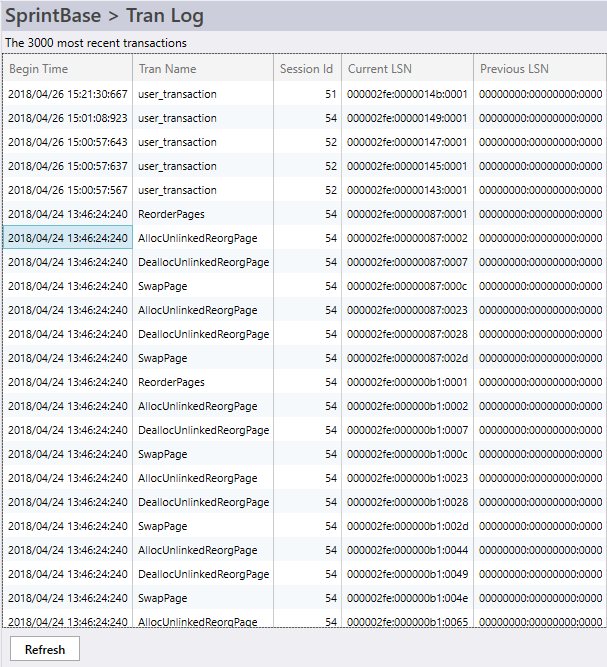
The log is written to when log buffer data is flushed and that is when new transactions appear. If your T-SQL uses names transactions it is easy to see if they have made it to the log file for low level log issue debugging.
The "Refresh" button loads the most recent data into the log viewer.
Read more about the logical and physical architecture of database tranaction logs in this MSDN article
The contents of the latest transaction log is displayed in this view, including individual LSNs:
The log is written to when log buffer data is flushed and that is when new transactions appear. If your T-SQL uses names transactions it is easy to see if they have made it to the log file for low level log issue debugging.
The "Refresh" button loads the most recent data into the log viewer.
Read more about the logical and physical architecture of database tranaction logs in this MSDN article