Legacy Documentation
Desktop And Mini DBA Server
Legacy Documentation Home
alerts
analysisservicesalerts
analysisservicescpu
analysisservicesdashboard
analysisservicesdatabases
analysisservicesio
analysisservicessessions
azurealerts
azuredatabase
azuredatabasehealthcheck
azureindexes
azurelocks
azure security
azuresessions
azuresql
azuresqldatabase
azuresqldatabasedashboard
azuresqldatabases
azure sql server dashboard
azuretables
azurewaits
compare performance baseline
connections
cpu
custom sql server alerts
database
database query performance
databases
defaulttrace
dm exec query statistics xml
documentation
errorlog
files
gettingstarted
healthcheck database
healthcheck sql server
history active
history blocking
history data storage
history deadlocks
history files
history memory
history viewer
history waits
howtoperformancetuneazuresqldatabase
how to performance tune sql server
how to sql server performance tuning
how to sql server query tuning
indexes
Installation
io
License Support
locks
maintenance windows
options
performance history
security
server
servergettingstarted
Server Installation
server memory
serveroptions
serversecurity
servertroubleshooting
sql database memory
sql execution plan
sql extended event sessions
sql server activity
sql server alert configuration
sql server alerts
sql server database
sql server execution plan view
sql server index defrag jobs
sqlserverindexfragmentation
sql server index fragmentation
sql server index maintenance
sql server live query statistics
sqlserverqueryperformance
sql server query performance
sql server send slack alerts
sql server send teams alerts
sql server transaction log
sql server wait statistics
tables
tranlog
waits
webmonitorconfigure
webmonitorconnections
webmonitorcurrent
webmonitorcustom
webmonitorenterprise
webmonitorgettingstarted
webmonitorhistoric
webmonitorinstallation
webmonitorio
webmonitormemory
webmonitoroptions
webmonitoroverview
webmonitorsecurity
webmonitorwaits
wmi
-
After installing Mini DBA run the application from the Windows Start menu. If it is the first time running you will be prompted to enter Sql Server instance details to connect to.
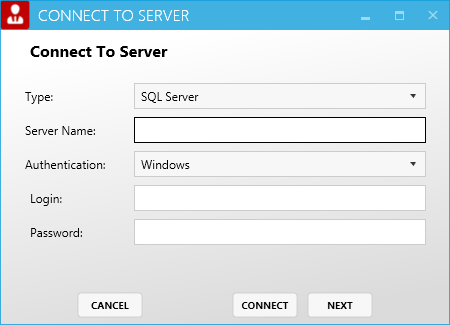
- Ensure Type: Sql Server
- Server Name: If you are connecting to a named instance then include that here
- Authentication: If your current Windows user security gives you enough permission on the Sql Server being connected to then leave authentication as windows. If you need to use Sql Server authentication including name and password then choose that here. Note: passwords are encrypted by Mini DBA using built in Windows encryption functions to ensure no sensitive data is held unencrypted by Mini DBA.
- Click Finish
- You will now be connected to the specified Sql Server instance, its server explorer visible in the left pane of Mini DBA and its server level dashboard in the right.
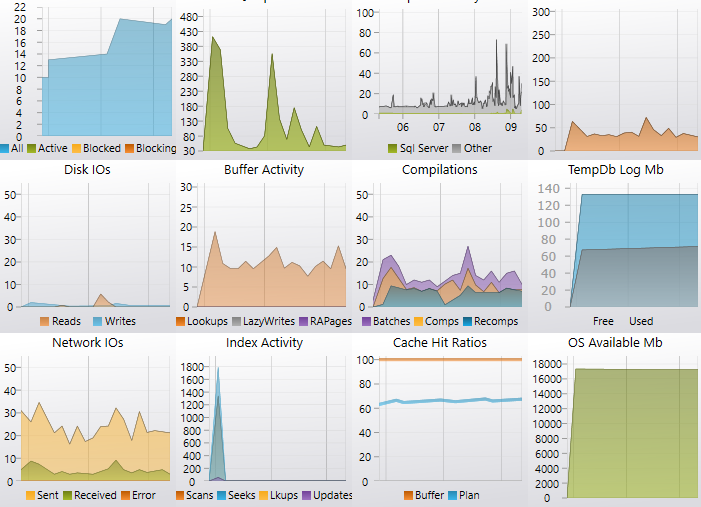
- The status bar at the bottom of the screen indicates what permissions you have on the server and that Mini DBA is currently sampling the server every 5 seconds.
- If at any time you would like to change how often the server is sampled right click its node in the left hand server explorer, select settings then alter the sample rate.
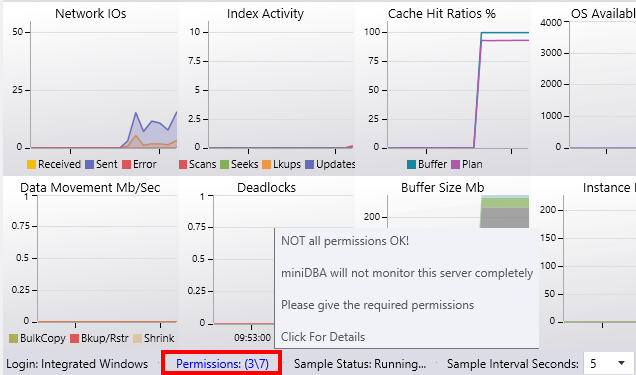
- The permission status link (in red in the above screenshot) tells you how many of the required sql server permissions the current account has.
- Click the link to see the permissions screen (below).
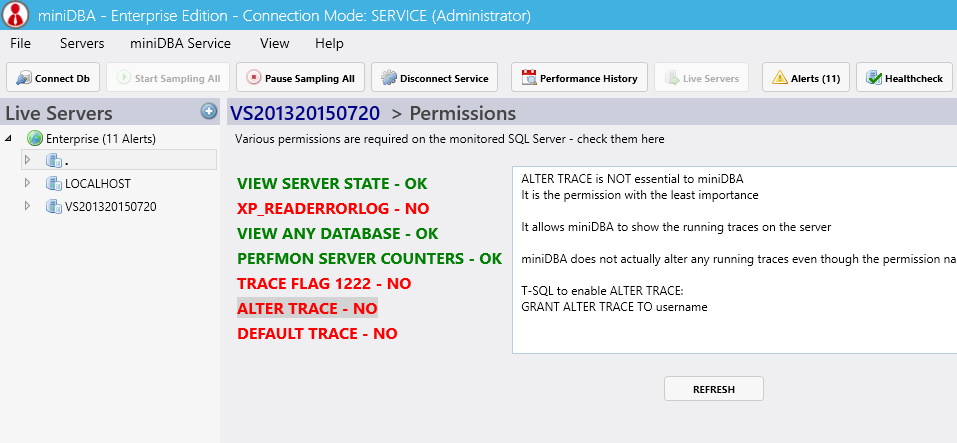
- The tabs on the left are green if the permission has been granted and red if not. A description of the permission and the T-SQL required to grant it is on the right.
- The more permissions that are given the more Mini DBA can do for you. The only permission that 100% must be given is VIEW SERVER STATE.
If you have multiple server to monitor click the plus button above the server explorer window to add more servers
Mini DBA will log all server activity every 60 seconds so after this point you can click the "History" button in the bottom left corner of the application and star viewing historic data.
To learn more about analysing historic data view the documentation
You may also be interested in the following topics to get you underway:
- Server Healthcheck
- Database Healthcheck
- Performance Tune SQL Servers